When tens of thousands of fans fill a stadium, audio becomes just as important as the game itself. Announcements must be clear, music must energize the crowd, and emergency messages must reach every seat instantly. Delivering that level of performance across such a massive space requires specialized audio engineering.
A stadium sound system is a large-scale professional audio system designed to distribute clear, intelligible sound across vast venues such as football stadiums, baseball parks, racetracks, and outdoor arenas. These systems combine powerful loudspeakers, digital signal processing, amplifiers, control systems, and network infrastructure to ensure that every announcement, song, or live event is heard clearly from the front row to the highest seat.
For organizations installing or upgrading stadium audio systems, professional AV integrators—such as those specializing in large-venue systems—design solutions that account for crowd noise, venue architecture, acoustics, and safety requirements.
Understanding the Purpose of a Stadium Sound System
At its core, a stadium sound system serves three primary functions:
- Public address announcements
- Entertainment audio
- Emergency communication
Unlike smaller PA systems used in conference rooms or auditoriums, stadium systems must operate across enormous spaces while overcoming environmental challenges such as wind, crowd noise, and open-air acoustics.
A properly designed stadium system ensures that:
- Announcements are intelligible even with loud crowds
- Music and entertainment audio maintain clarity and impact
- Emergency alerts reach every spectator immediately
- The system can be controlled easily from a central operations booth
Without advanced audio engineering, sound in a stadium would quickly become muddy, delayed, or distorted.
Key Components of a Stadium Sound System
A stadium sound system consists of several integrated components that work together to deliver consistent audio across a large venue.
1. High-Power Loudspeaker Arrays
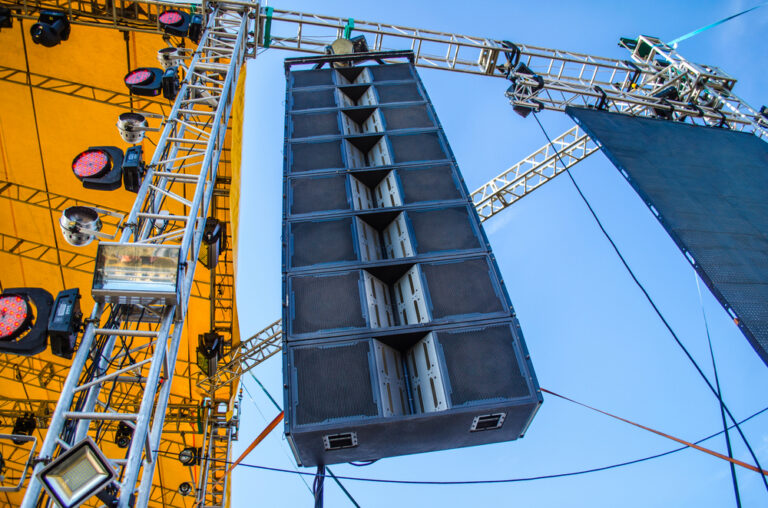
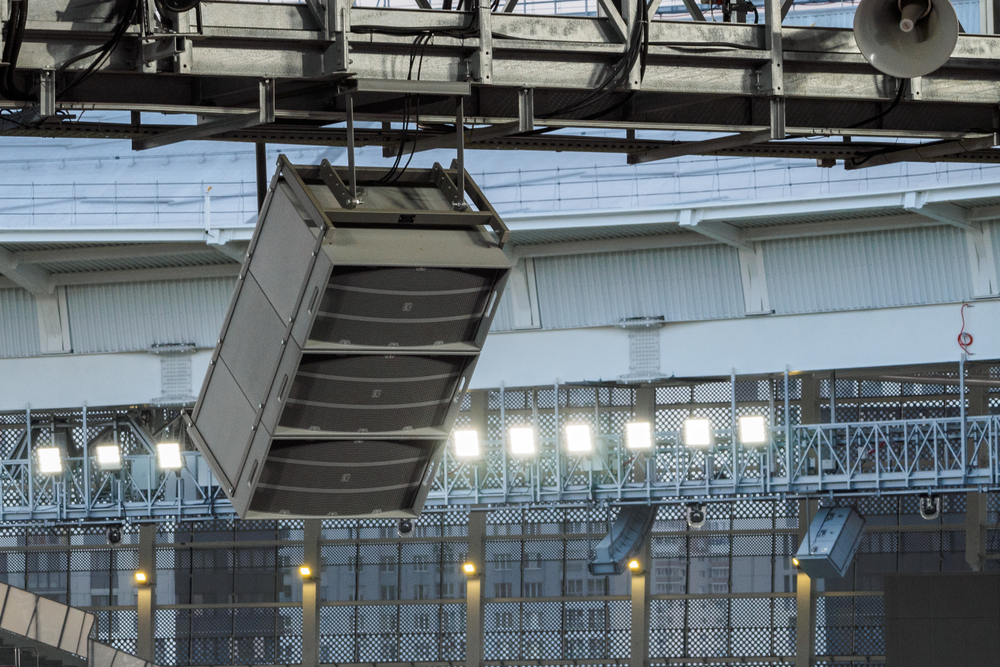
The most visible part of a stadium audio system is the loudspeaker arrays mounted throughout the venue.
These speakers are strategically placed to provide even coverage without excessive echo or delay.
Common placements include:
- Roof trusses
- Catwalk structures
- Scoreboards
- Lighting towers
- Upper deck overhangs
Most stadiums use line array speaker systems, which project sound in controlled patterns to reach long distances while minimizing audio spill.
Manufacturers such as JBL Professional, Meyer Sound, and Bose Professional are widely used in large venue installations.
2. Digital Signal Processing (DSP)
Digital signal processors act as the brain of the sound system.
DSP technology controls:
- Equalization
- Delay timing
- Frequency response
- Audio routing
- Feedback suppression
Because sound travels differently across large spaces, DSP systems synchronize audio across hundreds of speakers to ensure that fans hear announcements at the same time, regardless of where they sit.
3. Power Amplifiers
Large venue systems require significant electrical power to drive high-output speakers.
Amplifiers boost audio signals so that sound can travel hundreds of feet without losing clarity. These systems are typically installed in centralized equipment rooms and connected through networked audio infrastructure.
Modern stadiums often use networked amplifier systems, which allow engineers to monitor performance and adjust audio remotely.
4. Mixing Consoles and Control Systems
Audio engineers control the stadium sound system from a central booth.
From this location, they manage:
- Live microphones
- Music playback
- Video board audio
- Broadcast feeds
- Crowd prompts and sound effects
Professional digital mixing consoles allow precise control over multiple audio sources during events.
5. Microphones and Input Sources
Stadiums rely on multiple microphone types depending on the event.
Examples include:
- Announcer microphones
- Wireless handheld mics for ceremonies
- Referee microphones
- Sideline microphones
- Performer microphones for concerts
All of these inputs feed into the central audio system, where they are mixed and distributed to the speakers.
How Stadium Sound Systems Deliver Even Audio Coverage
One of the biggest challenges in stadium audio design is ensuring consistent coverage.
In a large venue, sound behaves very differently than in a smaller indoor space. If the system is poorly designed, some sections may hear delayed or echoing audio while others receive overly loud signals.
Professional AV engineers solve this using several techniques.
Acoustic Modeling
Before installation, engineers use computer modeling software to simulate how sound will travel throughout the venue.
These models consider:
- Stadium architecture
- Seating layout
- Structural materials
- Environmental noise
The result helps determine optimal speaker placement.
Time Alignment
Because sound travels roughly 1,125 feet per second, delays can occur between speakers placed far apart.
DSP processors apply time-alignment delays so that audio arrives simultaneously throughout the stadium.
Directional Speaker Coverage
Line arrays and horn-loaded speakers focus sound toward seating areas instead of open air.
This improves clarity while reducing echo and unnecessary noise pollution outside the venue.
Indoor vs Outdoor Stadium Audio Systems
The acoustic design of a stadium system changes dramatically depending on whether the venue is indoors or outdoors.
Outdoor Stadium Systems
Outdoor venues present unique challenges:
- Wind interference
- Open-air sound dispersion
- Environmental noise
- Long throw distances
These systems require extremely powerful speakers capable of projecting sound across large open spaces.
Indoor Arena Systems
Indoor arenas must deal with:
- Echo and reverberation
- Reflective surfaces
- Ceiling height limitations
Acoustic treatment and careful speaker positioning become critical to maintaining speech intelligibility.
Why Audio Clarity Is Critical in Large Venues
Poor stadium audio affects more than just entertainment. It can also impact safety and operations.
Clear stadium audio supports:
- Crowd engagement during games
- Sponsor messaging and advertising
- Game announcements and commentary
- Emergency evacuation instructions
- Coordination between staff and security
Modern stadiums rely on integrated AV systems that connect audio with video boards, broadcast feeds, and venue management platforms.
Integration With Modern Stadium Technology
Today’s stadium sound systems are rarely standalone audio installations. Instead, they function as part of a broader AV ecosystem.
Modern systems integrate with:
- Video boards and scoreboards
- Digital signage networks
- Video conferencing systems for press events
- Streaming and broadcast production
- Emergency notification systems
For example, during a major sporting event, the stadium audio system may simultaneously distribute sound to the venue, broadcast trucks, VIP suites, and online streaming feeds.
The Role of Professional AV Integrators
Designing a stadium sound system requires specialized expertise.
Professional AV integrators evaluate several factors before installation:
- Venue size and architecture
- Event types hosted at the stadium
- Acoustic characteristics
- Crowd capacity
- Infrastructure and networking needs
Companies like High Country Low Voltage, which specializes in large-scale audio-video installations—such as digital signage, mass notification systems, public address systems, and large-venue audio—often handle stadium system design, installation, and ongoing maintenance.
This ensures the system performs reliably during high-pressure live events.
Signs a Stadium Audio System Needs an Upgrade
Many older stadiums were built decades ago and rely on outdated PA systems that struggle to meet modern expectations.
Common indicators that a stadium system needs upgrading include:
- Poor speech intelligibility
- Uneven sound coverage
- Frequent equipment failures
- Limited system control
- Inability to integrate with modern AV platforms
Upgrading to a modern digital audio infrastructure can dramatically improve both fan experience and operational efficiency.
The Future of Stadium Sound Systems
Advancements in audio technology continue to transform large venue sound systems.
Emerging innovations include:
- Networked audio systems using AV-over-IP
- Beam-steering speaker arrays
- AI-assisted audio optimization
- Integrated broadcast-quality sound systems
- Advanced crowd engagement audio effects
As stadiums become more technologically advanced, sound systems are evolving into fully integrated communication platforms that enhance the entire event experience.
Frequently Asked Questions
What is a stadium sound system?
A stadium sound system is a large-scale public address and entertainment audio system designed to deliver clear sound throughout a sports stadium or arena. It uses powerful loudspeakers, amplifiers, digital processors, and control systems to ensure announcements, music, and emergency messages reach every seat.
How powerful are stadium sound systems?
Stadium sound systems can produce extremely high sound pressure levels and often require thousands of watts of amplification. Large venues may use hundreds of speakers and multiple amplifier racks to provide adequate coverage across tens of thousands of seats.
Why do stadiums use line array speakers?
Line array speakers project sound in a controlled vertical pattern, allowing audio engineers to direct sound toward seating areas while minimizing echo and wasted sound energy. This design improves clarity over long distances.
How do stadium sound systems avoid echoes?
Audio engineers use digital signal processing to apply precise timing delays between speaker arrays. This ensures that sound from different speakers reaches listeners simultaneously, preventing echo and phase issues.
Can stadium sound systems be used for concerts?
Yes. Many stadium audio systems support concerts, live performances, and entertainment events. However, touring concert productions often bring additional sound equipment tailored specifically for the performers and musical requirements.
Who installs stadium sound systems?
Stadium sound systems are typically designed and installed by professional AV experts specializing in large venue audio solutions. These companies handle system design, acoustic modeling, installation, programming, and ongoing maintenance.
If You Need A Stadium Sound System
Be sure to reach out and ask about our stadium sound system services. Call us at 720-575-2494 or use our secure online form. You can also check all the other A/V projects we’ve helped our clients with – just click here.